Showing posts with label garbage. Show all posts

Sunday, September 29, 2013

Cleaning up the Beach along the Old Airport Road, Montego Bay

   I was wondering where to start on my account of our beach clean-up on the old airport road, when I read Judith’s poem, “Garbage Runs”, written for International Beach Clean-up Day. It says it all!
Bags of garbage collected at Old Airport Beach
Why spoil the view ?

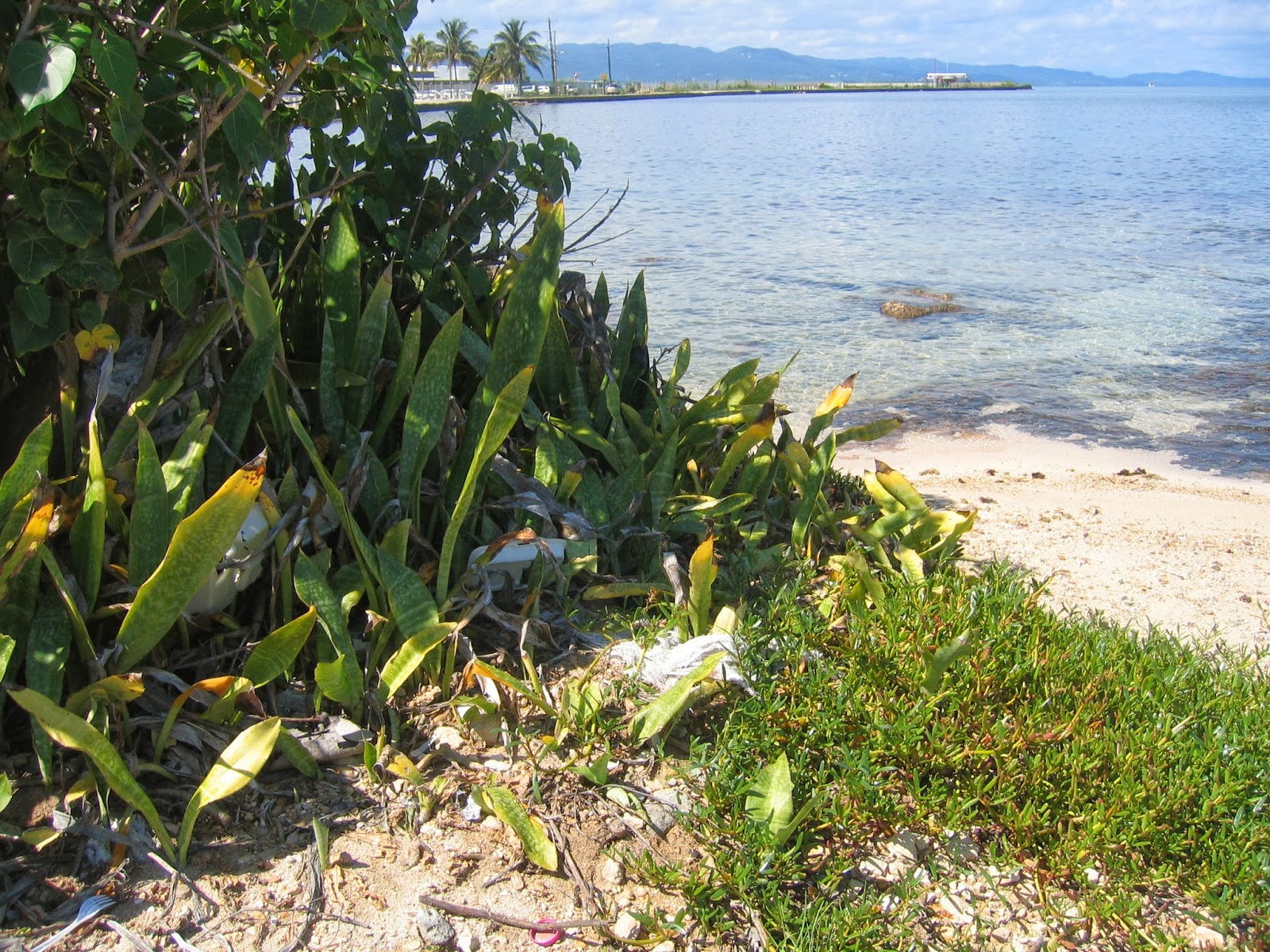
     Many years ago, I used to take students on field trips to the old airport beach, where, at low tide we could use sampling methods, such as line transects, belt transects and quadrats to estimate numbers and distribution of species of nerite and sea urchin. Not much has changed. It is still a popular spot for people to sit and eat from Styrofoam boxes, and drink from plastic bottles or cans, use condoms, and then toss their garbage into the ‘bush’. My questions to these people are, “Do you like to come to the beach and find garbage? Is that why you leave your garbage here?” Perhaps fewer people visit here because of the mess left by others. Will they return now we’ve cleaned it up? If they do will they take their garbage home with them and dispose of it appropriately, including the recycling of plastic bottles? It would be interesting to return in a few weeks and see.
    I was curious about how quite a few pieces of clothing – blouses, shirts, a skirt, a belt – came to be where they were, tangled up with rocks and driftwood, in the sea beside the road. I suspect they were carried there by the storm surge after Hurricane Sandy.
What's tangled up in the driftwood?
Oh! It's a blouse.


A storm surge would also account for the amount of ‘old garbage’ half-buried by sand and fallen leaves. The main change I noticed since I was last there, (about fifteen years ago), was that the vegetation between the road and the beach had grown taller and denser, I suspect hiding more garbage we couldn’t reach. It also provides a refuge for crabs and mongooses.
This crab could still walk in spite of lost legs.
    The group I was in didn’t go beyond the old airport beach, but other groups went as far as Tropical Beach. The clean-up was scheduled to end at eleven, by which time thunder had begun to roll and rain to sprinkle, but not before the volunteers, most of whom are employed at the airport, had assembled for a group photo. The coordinator was Mr. Orville Grey.
   At the same time, other beaches from Freeport to Dump-up were being cleaned by a total of 800 volunteers from  Service Clubs, NGO's and corporate Jamaica.Over 4000 lb of garbage was picked up  The whole Montego Bay Beach Clean-up was organized by Montego Bay Marine Park Trust. Congratulations on a job well done!
Volunteers pose for the camera.

The Beach Clean-up brings into focus the larger question of attitudes to garbage in general. Careless disposal of garbage is not confined to Jamaica (100 countries had Beach Clean-ups on Saturday, September 21), nor is it confined to any social class, political affiliation or religious persuasion. I knew of people in England who encouraged their children to drop garbage in the street because – “People are paid to sweep the streets.”  When I had my school, some parents objected to my asking children to take their turn in picking up litter from the yard - litter the children had dropped.  The residents of some countries are more particular. When I was with a group of students on a visit to Mexico, in 1972, a girl who dropped a sweetie wrapper was told, “We don’t do that here.”

        Efforts to improve attitudes in Jamaica, including “Best Kept Community” competitions, advertising campaigns, “Anti-litter Laws” (hard to enforce), seminars, workshops, and exhortations by environmentalists to “Reduce, Reuse and Recycle”, don’t seem to have made much of a difference. Attitudes are hard to change, but there are some incentives which could be put in place. All PET plastics can be recycled. If a refundable deposit was charged on these bottles, fewer of them would end up in the garbage. Styrofoam is highly toxic and carcinogenic, especially when it dissolves in fatty foods, or is heated in a microwave, or worse still, thrown on a fire. My recommendation is a total ban on Styrofoam containers. We lived without them before and could do so again. 
        There’s slogan on the side of some garbage trucks: “Jamaica’s beauty is our duty”.  All of us living in Jamaica, disposing of our garbage responsibly, can help to keep her what she is, one of the most beautiful places on earth. 


Yes, I was there.

Thursday, August 15, 2013

Zero Tolerance or Infinite Tolerance?

“A zero tolerance policy imposes automatic punishment for infractions of a stated rule, with the intention of eliminating undesirable conduct.” (Wikipedia). The “broken window theory” claims that if a window is broken and not repaired, more windows will be broken and eventually the building will be broken into. Extrapolating that argument, if minor infractions of rules go unpunished, the perpetrators or people in general will continue to expect to be able to  break other laws and not be punished. Arguments and examples can be put forward supporting and  opposing this theory.
Garbage on Sewell Avenue, Montego Bay

However, in Jamaica, the attitude of infinite tolerance seems to prevail. No action is taken against those who break so many of our laws. Take for example the Anti-Litter Act, passed with much fanfare and education programmes in the 1980’s. There are occasional crackdowns, in relation to posters advertising events, but in general there is total disregard for this law. Our drains and gullies are filled with plastic bottles, Styrofoam boxes and other trash to such an extent that they are blocked when heavy rains come and flooding results. Parish Councils are called on to keep these waterways clean, but you never hear of anyone being penalized for dropping the garbage there in the first place. On Sewell Avenue, in Montego Bay, there are two spots where people dump their garbage in an unsightly pile. Garbage trucks pass by regularly and sanitation workers take it up, but minutes later more is deposited. People, where is your civic pride? Couldn’t somebody at least provide a garbage drum at this location?
Open burning

Very few people seem to be aware that there is a law against open burning – a common practice. It’s hard to detect somebody littering - they drop their garbage and disappear, but it’s easy to see smoke and the evidence of a fire in an urban area. If Parish Councils collected fifty-thousand dollars for every instance of open burning, they would need no other source of income.
Slash and burn farming, Caledonia, Westmoreland

Harder to catch are slash and burn farmers in deep rural areas, and those who cut down trees with the intention of selling them. Police in Westmoreland have expressed their frustration at not being able to catch these thieves.
  Another law which is flouted with impunity is the night noises law. Operators of sound systems are supposed to get police permission before holding a session, but many fail to do so. Their noise continues well beyond the stipulated cut-off time and is replete with ‘forty-shilling-words’ which in a different setting would be grounds for an arrest.
  At one time, it was forbidden to import Pit Bull Terriers, and all imported dogs had to be quarantined for six months, to guard against rabies. Pit Bulls and other dogs were sneaked in, by-passing the quarantine. As far as I know, the law forbidding their importation is still on the books, but now Pit Bulls are one of the commonest breed of dog to be found in Jamaica.     
Even the government breaks its own laws by locking up children in adult prisons, and keeping adult prisoners incarcerated for many months without charging them.
  I hadn’t intended for my blog to be a platform from which to rant, as I prefer to be positive and look for solutions. I asked myself whether I would reproach anybody I saw dropping or burning garbage, and the answer was “No”, (except in the case of our neighbour’s gardener to whom we’ve spoken numerous times). However, I know there are many people who think as I do. I’ve heard them on talk-shows and seen their letters in newspapers. By continuing to talk and write, we must make it known that we are the majority, we disapprove of indiscipline and we shouldn’t let ourselves be bullied. We can also lend our support to organizations such as Jamaicans for Justice, and Jamaica Environment Trust, by thanking them and encouraging them to continue to speak out on our behalf.