Showing posts with label Jamaica. Show all posts

Tuesday, June 7, 2016

Launch of Ellen Pearl Outreach Children’s Charity (EPOCC)

A children’s charity with a difference was launched on Friday, May 27, 2016 at the UWI Western Campus. The Ellen Pearl Outreach will be the medium through which children in need of help can telephone a trained counsellor to talk about their problems. At the launch, its founder, Mrs. Beverley Chung spoke about its inception, and Dr. Pearnel Bell told us how it will work in Jamaica. Stakeholder groups brought greetings and children entertained with song and poetry. The keynote address was given by Juliet Holness, MP for St Andrew East Rural, graciously standing in at short notice for The Hon. Marlene Malahoo Forte Q.C., MP, who was indisposed.
     After delivering her opening remarks, Joy Crooks, Nurse Administrator at CUMI invited Rev. Lenworth N Anglin to lead us in prayer, followed by greetings from stakeholder groups.
     Mrs. Gage-Grey of the Child Development Agency (CDA) welcomed the contribution that this charity offers. 10 in every 1000 children are in need of intervention, meaning 8000 children for their population in Jamaica. The CDA is on a mission to protect children and looks out for ways of getting involved in the national conversation. We need to see each child as our own. CDA endorses EPOCC and looks forward to a meaningful partnership.
     Dr  Claudette Crawford-Brown, Lecturer in the Dept. of Social Work at UWI brought greetings from that institution, and from  Jamaica Association for Social Workers, and from other organizations she represents. After 40 years in child advocacy, she recognizes that the social status of the child is in a lot of trouble.   I wrote in my notes that 100 children were murdered in 2015. (I hope I made a mistake and that that isn’t true.) Only one child was murdered in 1993. Sexual abuse is increasing at an alarming rate. 700 children went missing. People are crying out for solutions, but the link between the micro-level and solutions is missing. This programme could pave the way to macro-level solutions.
     Mrs. Debbian Livingstone Edwards brought greetings from the Office of the Children’s Advocate, (OCA). She also welcomed the programme because children require free and ready access. There is a gap in the availability of psychosocial services, and there is a need for sustained counselling.  She reminded us that it is our civic duty to protect the rights of children.
     Greetings from FLOW/Lime Foundations was to have been brought by Mrs. Shellian O’Connor, who was unavailable because of illness, but she assured EPOCC of their commitment.
     Corinaldi Avenue Primary School choir treated us to an emotional rendition of their song; and Mount Alvernia High School’s Susanna Hyde, Child Ambassador for the OCR for Region 4, performed a poem about a boy accused of stealing. I wasn’t sure if he was guilty or not, but Susanna’s enactment made us feel his fear and sense of isolation.
      We saw Ms. Ottoa Wilson busy videotaping the launch, and were then introduced to her work – a short video about child abuse in Jamaica, and her paintings and drawings displayed around the room. 
    
  Mrs. Beverley Chung, who was born in Catadupa, St James, but left Jamaica when she was nearly 9, took us on her journey to the founding of EPOCC. She keeps in touch with Jamaica and is distressed about what is happening. She wrote a poem entitled Jamaica Weeps, Jamaica Bleeds. Inspired by a visit to Bridge of Hope Charity in Uganda, her question “Why don’t they do something?” became “Why don’t I do something?” She knew that she herself had the skills to run a charity, inherited from her grandmother, Ellen, and he mother, Pearl, who both started churches and for whom EPOCC is named. She also had experience of working with Childline in the UK.  She shared her vision with Dr. Pearnel Bell and Nurse Joy Crooks, who both said, “We need to listen to children”.  A further impetus came from Sir Patrick Allen, Governor General of Jamaica’s address to the 6th Biennial Diaspora Conference (June 2015), in which he encouraged support for community projects that would positively impact the lives of children. Hence EPOCC was born.

EPOCC’s vision is to improve the lives of children.
 Mission -Initial Aims:
  • To provide a national free 24hr helpline service manned by fully trained counsellors
  • email and Web-chat counselling service for children on any problem whatsoever
  • Register of services with appropriate referrals
 
Long-Term Aims:

  • Visit to schools, youth clubs/centres and churches to inform on abuse awareness and to empower children to say 'no' and/or to report abuse
  • Transitional opportunities and mentoring post 18 years for children that have been in care
  • Further educational opportunities for disadvantaged youths

Trustees

In the UK: Beverley Chung, Roger Panton, Jacqueline Longmore, Mrs. Cecelia Ellis (UK Treasurer), Mrs Emma Barton (Fundraiser).

In Jamaica: Joy Crooks (Secretary), Dr. Pearnel Bell, Hopeton Ridgard – Board Member for Finance; employed at JMMB; works in youth ministry.

Mrs. Chung had consultations with Esther Rantzen, who started Childline in the UK. Subsequently,

On Oct 12, 2015, EPOCC was launched in the UK.

From Oct ’15 to Jan’16, the organizational structure was worked out.

From June to September 2016, the training of volunteers will take place.

How you can help: sponsorship, advocacy, fund-raising and volunteering. Together we  can change the future of our children.

Dr. Pearnel Bell then spoke about Jamaica Childline. There was a helpline in Jamaica before, but it only lasted 7 years because of lack of support. It is needed more than  ever now with mental health problems escalating. The incidence of untreated mental health problems becomes a public health problem.
          They are actively recruiting volunteers, and 60 persons have applied so far. They will be given 40 hours of training. An international trainer will train the trainers in Jamaica. The government agencies: OCR; CDA and OCA will be present at the training.
          A SWOT analysis was performed:
Strengths – Trustees in UK and Jamaica. Aggressive fund-raising’

Weaknesses – lack of support from stakeholders; keeping in touch with stakeholders.

Opportunities – for sponsorship and to achieve.

Threats -  lack of support from stakeholders; naysayers; financial sustainability; numbers of volunteers.          

However, with 3 universities and 1 college on board, it is hoped that EPOCC will prevail.
Mrs. Juliet Holness in conversation with Dr. Pearnel Bell
 
“If we don’t stand up for our children, we stand for nothing,” said the dynamic Kimone Clarke, a social worker, in introducing The Guest Speaker, Mrs. Juliet Holness, MP for St Andrew East Rural, and wife of Prime Minister, Mr. Andrew Holness. Ms. Clarke piled on ‘special’ after ‘special’ in describing Mrs. Holness, who demonstrates in word and in deed that she stands up for children.
Keynote Address
“Children are a gift from the Lord and a blessing” quoted Mrs. Holness. She then debunked two common sayings used in relation to children.

1.     “Spare the rod and spoil the child” is often quoted as a command to beat children. However, the rod is not intended for beating. The shepherd’s rod was used to guide the sheep, not to beat them. There are other ways of punishing children, such as time-out and withholding privileges.

2.     “Children should be seen and not heard.” Children do make excessive noise sometimes, but it is our responsibility to listen to children as well as talk to them, so that we can be sure we understand each other. Body language is not sufficient engagement. They can tell right from wrong and know how to trick you.

It is our responsibility to build children’s self-esteem.

Re the internet: many people are fearful of children using the internet, rightly so as there are pitfalls. While it is useful for children to be able to do their own research, we need to pay attention to what they are doing on the internet. Children push hard against rules and norms, so parents and other adults in charge of children must give guidance to give support for positive development.
     She welcomed the launch of EPOCC, pointing out that child abuse includes emotional abuse; and that we don’t realize how many children are in need of this service. A desperate human is one with no hope. She implored us to support the work of EPOCC.
     The function closed with the presentation of an orchid to Mrs. Holness by Hopeton Ridgard; Vote of Thanks by Mrs. Janette Allen; Closing Remarks by Joy Crooks; and closing prayer by Rev. Milton Davidson.  


Monday, May 23, 2016

Diagnostic Testing of Basic School Children in Jamaica

Rose Davies
          In the past, the curriculum in Jamaican primary schools tended to be knowledge based with an emphasis on factual information to be learnt by rote rather than a learning-how-to-learn approach. The one-size-fits-all method of imparting information does not allow for differences in learning styles and rates by different children. The result of this approach has been that some children get left behind and turned off education, so at the end of 11 years of schooling too many end up with no qualifications. Some drop out of the system without having basic literacy and numeracy skills.
To address this problem, the Ministry of Education introduced the Grade 4 literacy test to identify children not performing at that level. They were required to have mastery in that test before being allowed to take the Grade Six Achievement Test. Because some children did not do so before being of age to enter secondary school, the Alternative Secondary Transitional Education Programme (ASTEP) was introduced. (See my blog post of March 22) It became obvious to those administering ASTEP that an earlier intervention was desirable. Then came GOILP – Grade One Individual Learning Profile, with children who were deemed not ready for Grade 1 being placed in a separate class.
        With the work of the Early Childhood Commission  over the last 10 or more years, there has been a great improvement in the standards of Jamaica’s Basic Schools. The great importance of early childhood education and early detection of learning difficulties has come to be recognized. After several years of preparation, the ECC on May 10 and 11, 2016, administered its first diagnostic testing of 4-year-olds in over 2000 Early Childhood Institutions, with the purpose of finding out whether a child has a specific learning disability or learning disorder with another cause, or even a behavior disorder, so that appropriate interventions can take place at the earliest possible time.  Interventions will be made by Regional Special Needs Coordinators and Regional Assessment Teams consisting of 2 psychologists and 2 diagnosticians. There is ongoing training of teachers in the area of special education. (See my blog post of April 14)

In the Sunday Gleaner of May 22, 2016, Rose Davies expressed her concerns about the methods of testing 4-year-olds, in an article entitled Cautions on Early Childhood Assessment. I share those concerns. I can understand the aim of the Early Childhood Commission that the assessment be as objective as possible, but as Mrs. Davies points out, that is hard to achieve with young children. Surely it would be reasonable to have in addition some subjective assessment also by the teachers who work with these children every day? Mrs. Davies also expressed concern about the absence of public information leading to the rollout of this assessment.
          In an article entitled  Pressure For Primary School Students - Pupils Face Four Prime Tests In Six Years” by Deika Morrison in The Gleaner of April 25, 2012, she wrote: (highlighting is mine).
   
Deika Morrison
      “The Early Childhood Commission (ECC), mandated to supervise and regulate the early childhood sector, is about to begin working on a national-evaluation tool for four year olds. They need to be evaluated for real readiness in the main developmental areas - gross and fine motor skills (gross means big movements like running, fine means small movements like picking up things with finger), speech, social skills, emotional skills, brain development and their approach to learning.

          According to the ECC, this evaluation tool will be specifically designed for Jamaican children and meant to identify what kind of support children need to go forward in the primary-school system. The idea is to be able to identify, before they enter primary school, which of the three categories children fall into: 1) need no additional support in the regular school environment 2) need additional support in the regular school environment or 3) need a specialised school environment.
           Chance for intervention
           The evaluation will be timed to allow for a full year of intervention for those lagging developmentally, as well as specialised attention if needs be. The bottom line is that four year olds don't need a four-year-old version of GSAT. If we are to get the maximum return for the necessary investment in early childhood education, then we must have appropriate tools - which we agree on as a nation - to identify the problems and deal with them appropriately.
          It is time for child-centric interventions, like evaluations that can best help children. We don't know when the ECC evaluation tool will be implemented, but we know we don't have 18 years to 2030 for all of our children to fully master the basics.”

In addition to carrying out diagnostic tests with the best of intentions, the ECC and MOE need to educate parents on the purpose of the testing – it is not to label a child as dumb or bright, nor is it to punish a child who performs poorly in a test. It is to find out the best way of helping children to learn and to grow up to become productive, healthy, well-adjusted members of society.


Thursday, April 14, 2016

Learning Disorders – the Struggle is Real Part 2

Mr. Karl Watson
This is the 2nd of 3 posts I am writing about a Symposium “Learning Disorders – the Struggle is Real” put on by the Association of Future Psychologists, a service club at the Western Campus of the University of the West Indies. Mr. Karl Watson was the final speaker at the symposium, but what he had to say flows logically from Dr. Shaw Salmon’s presentation, the subject of my 1st post. She told us about the children who end up in Grade 7 with poor or non-existent reading abilities. Mr. Watson, who is a Regional Special Needs Coordinator with the Ministry of Education, explained the strategies which will be used to identify and address children’s special needs at the earliest possible time. He was an entertaining speaker, frequently replacing his references to “the government” by “sorry, the previous government”, it being only a week after the general election. I am sure he is happy that the new minister has assured the nation that policies will remain the same. He began his address by pinpointing some of the landmarks in Special Education, and lamenting some attitudes.
      For children with special needs:
  1928 saw the establishment of the Salvation Army School for the Blind, and in
  1938  Rev. F.W. Gilby established the Jamaica Schoolfor the Deaf .
     There was no provision for children with intellectual disabilities until 1956, when the Randolph Lopez School of Hope was established.
      In 1975 Jamaica benefitted from a bi-lateral arrangement with the Netherlands government, through which the following were established:
  • A formal teacher training programme in special education at the Mico Teachers’ College (now Mico University College)
  • The Mico Child Assessment and Research in Education (CARE) Centre for diagnostic and therapeutic services for children across the region.
  • Seven (7) self-contained special education units in primary schools, offering intensive instruction for children with special educational needs
At that time, there was reluctance among primary schools to house the special education units because of the stigma attached to special ed. children. Mr. Watson found, during a feasibility study he conducted 3 years ago, that the fear of stigmatization still exists.  
In developed countries, the pendulum has swung from having special schools to including children with special needs having their needs addressed in mainstream schooling. The debate continues about whether this is the best approach. In Jamaica, in 2004, a Task Force on Educational Reform presented its findings to the Ministry of Education, resulting in the Education System Transformation Programme  (ESTP). Implementation of the recommendations has been ongoing since 2005. Among the major activities of ESTP is the improvement of provisions for Special Education.

To effect these improvements, a National Special Needs Coordinator (Dr. Meredith) was appointed, together with Regional Special Needs Coordinators for each of the 7 regions. Regional Assessment Teams consisting of 2 psychologists and 2 diagnosticians were set up. One of their first activities was to identify children with special needs – 7628 were identified in 302 schools. In response, work has begun to establish 20 additional pull-out classrooms and 2 additional self-contained Special Ed Units. A system of early identification and referral, supported by Regional Assessment Teams has begun. The MOE continues to provide examination accommodation for children sitting national examinations.

Over 3000 teachers and MOE personel  have benefitted from training in several areas including strategies to identify special educational needs; Applied Behaviour Analysis (ABA) for work with children with Autism Spectrum Disorders; Proficiency Pathway: A guide for instruction and intervention at the primary level; and Positive Behaviour Support and restorative discipline.

The Special Education Unit in the MOE cannot operate in isolation and requires the support of other agencies. Aspects of support include    
  • Continued collaboration with the Guidance Counseling Unit of the MoE; and the Child Guidance Clinic of the Ministry of Health.
  • The recently launched diagnostic and therapy clinic for pre-school children at VOUCH, in conjunction with the Jamaica Teachers’ Association (October 2014).
  • Mobilization for the establishment of three diagnostic centres at Sam Sharpe Teachers’ College in St James, Church Teachers’ College in Manchester, and the College of Agriculture Science and Education in Portland. These are scheduled for completion by 2016. 

There will also be more public education for parents with regards to special ed.

The most important step in providing education tailored to suit every individual is the early identification of their needs. Hence the introduction of assessment before grade 1. Based on this assessment each child would be deemed ready, not quite ready or not ready and taught accordingly. At the end of Grade 2, there is a diagnostic test to monitor progress. Towards the end of Grade 4, there will continue to be literacy and numeracy tests. In 2018, GSAT will be replaced by the Primary Exit Profile (PEP). Alternative Secondary Transitional Education Programme (ASTEP) will be replaced by Alternative Pathways for Secondary Education (APSE).
At the launch of APSE

At every level in the education system, efforts will be made to teach children in the way they can learn and for them to use their abilities to the optimum. Quoting from the Nathan Ebanks Foundation Conference on Inclusion “Creating Pathways to Inclusive Education”:
The outcome we desire cannot be accomplished with ‘chalk and talk’; as Aristotle said: ‘Educating the mind, without educating the heart is no education at all’. We need the engagement and involvement of all concerned at every level, since ‘Education is not preparation for life ... education is life itself’ (John Dewey).


Monday, March 28, 2016

Shifting Sands at Doctor's Cave Beach

 
The purpose of this post is to illustrate the way in which hurricanes, storms, tides and currents shift the sand at Doctor’s Cave Beach in Montego Bay. However, first here is a little history, taken from Doctor’s Cave website.
   It began in 1906 when Dr. Alexander James McCatty generously donated his beach property to found a bathing club in Montego Bay. The Club got its name because it was used by Dr. McCatty and his friends, who were mainly from the medical profession and, at that time they entered the tiny beach through a cave. The cave however, was destroyed by a hurricane in 1932. The water which is crystal clear has a temperature range, winter and summer from 78 to 84 degrees Fahrenheit, 22 to 28 Celcius.
     In the end of early 1920's, Sir Herbert Barker, a famous British Osteopath visited the beach and later published an article boosting it by declaring that the waters have curative powers and that he was restored to good health after bathing there. He said the waters could cure several ailments. This heightened the allure of the beach and Doctor's Cave became famous overnight as foreigners, many rich and famous came to try the water. Hotels were built in the immediate vicinity and thus began the tourist trade.


The following information is taken from History of Doctor’s Cave by Emile Martin in Doctor’s Cave Bathing Club 80th Anniversary Souvenir. (1986)
In 1932, a hurricane destroyed the cave and as a result the entire layout of the bathing club saw drastic changes with considerable improvements to the facility. With better accessibility, the large beach came into its own.
In the 1940’s another severe hurricane swept away much of this beach and the trustees employed an American expert, Sidney Makepeace Wood, to restore it. He designed and built concrete groynes to harness sand-bearing tides and currents. As a result, the beach grew to about 20 times the original size.

         At one point there was a diving platform at the end of the west groin, but it collapsed into the sea during a storm. The remains of it can be seen encrusted with corals.
        The photographs below show changes in the beach over a period of seven years.
August 2009

In this photo, taken in August 2009, you can barely see the top of a concrete column sticking up above the sand, and sand comes to within about a foot of the top of the walkway. Many years ago there was much less sand on the beach and this walkway was a jetty to which boats could be tied.


November 2012, after Hurricane Sandy


The next two photos were taken in November, 2012, about a week after hurricane Sandy had scoured away the sand under the walkway. The two concrete columns are completely exposed.
The picket fence was erected at the end of the walkway soon after these photos were taken.
November 2012, after Hurricane Sandy

By November 2014, the sand had built up again under the walkway, completely covered the concrete columns and extended further into the sea, entirely as a result of forces of nature.
November 2014

November 2014. The sign warning of concrete columns
under the sand may appear superfluous to the unwary.

View of eastern end, August 2009


At the eastern end of the beach also there is a cycle of sand building up and being washed away by the action of the sea.

In 2015, part of the groin broke away. Waves surged in and gouged out a section of the beach in a matter of days.
Breach in the groin, March 2015
 When a gabion basket filled with rocks was put in the breach, the beach came back again equally quickly.

February 2016. Rough weather piles up more sand on the beach.


The effects of the weather are no less dramatic under the sea surface. During calm weather, assorted seaweeds and turtle grass thrive. During hurricanes and winter storms, tons of sand churned by water scour rocks and the sea-bottom, ripping them away. Roots of turtle grass remain, new leaves soon sprouting from them. Dome-shaped flower, star and brain corals in the reefs withstand many storms, but the branching staghorn corals are easily broken and survive only in sheltered pockets. As reefs and turtle grass beds serve to protect the beach from erosion, every effort should be made to preserve them, including allowing parrot fish to live.


Thursday, February 11, 2016

1000 Black Girl Books


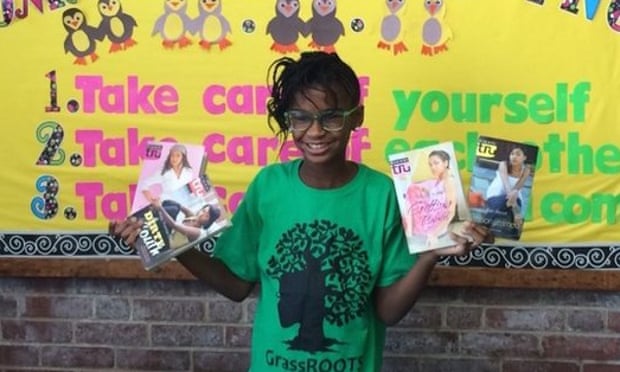
Marley Dias, with some of the #1000blackgirlbooks.
Marley Dias with some of her 1000 books
11-year-old Marley Dias, whose mother is from St. Mary, Jamaica, was frustrated with being given books to read about white boys and their dogs. Her mother, Janice Johnson Dias, asked her what she was going to do about it, so in November, Marley, with the help of her mother, launched a drive to collect 1000 Black Girl Books. 
          At Stacked Books, author and blogger Kelly Jensen raised nearly $3,000 in donations to help “this fabulous girl collect the books she wanted to meet her goal”, sending Dias a huge range of picture books, young adult titles and more.

Bookseller Barnes & Noble also donated books to the drive, saying that “some books introduce us to characters who are different from us, allowing us to see the world from a new perspective. But for children in the process of figuring out who they are, and who they want to be, it is just as important to also read stories about characters they can relate to, and see themselves in.”
Marley also appeared on US chat show Ellen, where she was given a laptop, and a cheque for $10,000 donated by Shutterfly. By February 9, 2016, she had reached her goal.
           This is an amazing achievement. Not only has Marley reached her goal, but she is also planning to donate the books to schools in the USA and to a library in St. Mary, Jamaica. I hope she will be coming in person to deliver these books and that she will get media coverage here.
       
   Marley’s drive highlights a problem. In the USA, where Kelly Jensen found that Black Girl Books were not as easily sourced, or prominently displayed as books about white children. When I first saw the hashtag “1000BlackGirlBooks”, I assumed that there were 1000 different titles, but that does not seem to have been the case. Kelly’s list included 45 picture books/early readers, 59 middle grade (8-12), 78 young adult (12-15), 16 Adult crossover, and 16 Graphic novels: total: 214.There was more than one copy of some books.
          In Jamaica, where at least 92% of the population is of African descent, the books available in bookshops and libraries do not reflect that. The bookshops display prominently books by Enid Blyton (1897 – 1968) considered to be racist by some people; Nancy Drew books; The Hardy Boys books; and The Diary of the Wimpy Kid, which is an-easy-to-read comic in book form and highly culture-bound. They don’t put Jamaican books on such prominent display (you have to search for them) and stock very few because, they say, “They don’t sell.” Who is buying these books? Mainly adults. Why are they not buying the Jamaican books? Because they don’t know about them. Diane Browne has written repeatedly about the need for Jamaican children to see themselves in books, but as Curdella Forbes pointed out  "Those who can afford to buy books have extensive options offered by the distributing giant Scholastic. With multiple outlets in the Caribbean, Scholastic leaves its local competitors far behind.” For lists of books by Jamaican authors, see my blog posts, for 8-12 year-olds and for younger children.
     The Jamaican Libraries, including school libraries, are mainly stocked by donations, so again the ethnicity and settings of these books don’t reflect the majority of the population and the Jamaican culture.  
      To be fair to the educational system and Ministry of Education, Jamaican and Caribbean books, including novels, plays and poetry, are on school book lists and on the CSEC  syllabus.
    
     Marley Dias is one in a million (many millions). I'm sure she won't mind us jumping on her band-wagon, and perhaps she will inspire Jamaican girls (and boys) to do something similar. But why is it, that up to now, children aren't asking for Jamaican books in book stores? Many of them never go into a book store or library. Of those who do, have they been brainwashed into thinking that there are no Jamaican authors and that only white people are heroes and heroines in books? And that it is more advantageous to have a white skin, hence the proliferation of bleaching? Perhaps Marley's drive can be a catalyst for change. Looking forward to hearing more about her.
Kelly Jensen’s list
Picture Books/Early Reader Title
  1. Abby by Jeannette Caines
  2. Anna, Banana, and The Big-Mouth Bet by Anica Mrose Rissi
  3. Anna, Banana, and The Friendship Split by Anica Mrose Rissi
  4. Anna, Banana, and The Monkey In The Middle by Anica Mrose Rissi
  5. Anna, Banana, and The Puppy Parade by Anica Mrose Rissi
  6. Anna Hibiscus (collection) by Atinuke
  7. Ballerina Dreams by Michaela DePrince*
  8. Black Mother Goose Book by Elizabeth Murphy Oliver
  9. Brown Angels: An Album of Pictures and Verse by Walter Dean Myers*
  10. Cassie’s Word Quilt by Faith Ringgold
  11. A Chair for My Mother by Vera B Williams
  12. Dancing in the Wings by Debbie Allen
  13. Don’t Call Me Grandma by Vaunda Nelson
  14. Ellington Was Not A Street by Ntozake Shange
  15. Firebird by Misty Copeland*
  16. The Granddaughter Necklace by Sharon Dennis Wyeth
  17. Her Stories: African American Folktales, Fairy Tales, and True Tales by Virginia Hamilton
  18. I Got The Rhythm by Connie Schofield-Morrison
  19. I’m A Pretty Little Black Girl by Betty K Bynum
  20. Jazz Age Josephine: Dancer, Singer, Who’s That, Who? Why That’s Miss Josephine Baker To You! by Jonah Winter*
  21. Josephine: The Dazzling Life of Josephine Baker by Patricia Hruby Powell*
  22. Keena Ford and the Field Trip Mixup by Melissa Thompson
  23. Let It Shine: Stories of Black Women Freedom Fighters by Andrea Davis Pinkney*
  24. Little Melba and Her Big Trombone by Katheryn Russell-Brown*
  25. The Little Piano Girl: The Story of Mary Lou Williams, Jazz Legend by Ann Ingalls*
  26. Mae Jemison: Biography by Jodie Shepherd*
  27. Molly by Golly: The Legend of Molly Williams, America’s First Female Firefighter by Dianne Ochiltree*
  28. Mufaro’s Beautiful Daughters: An African Tale by John Steptoe
  29. My Three Best Friends and Me, Zulay by Cari Best
  30. Hair Dance by Dinah Johnson*
  31. One Plastic Bag: Isatou Ceesay and the Recycling Women of the Gambia by Miranda Paul* http://www.amazon.com/One-Plastic-Bag-Recycling-Millbrook-ebook/dp/B00SG5YQ74/ref=sr_1_1?s=books&ie=UTF8&qid=1455138773&sr=1-1&keywords=one+plastic+bag+isatou+ceesay+and+the+recycling+women+of+the+gambia  
  32. One Word from Sophia by Jim Averbeck
  33. Pecan Pie Baby by Jacqueline Woodson
  34. Ruby and the Booker Boys #1: Brand New School, Brave New Ruby by Derrick Barnes
  35. Ruby and the Booker Boys #2: Trivia Queen, 3rd Grade Supreme by Derrick Barnes
  36. The Secret Olivia Told Me by N. Joy
  37. She Loved Baseball: The Effa Manley Story by Audrey Vernick*
  38. The Story of Ruby Bridges by Robert Coles
  39. Sugar Plum Ballerinas: Plum Fantastic by Whoopi Goldberg
  40. Sugar Plum Ballerinas: Toeshoe Trouble by Whoopi Goldberg
  41. Swing Sisters: The Story of the International Sweethearts of Rhythm by Karen Deans*
  42. Tar Beach by Faith Ringgold
  43. Voice of Freedom: Fanny Lou Hammer by Carole Boston Weatherford*
  44. Wangari Maathai: The Woman Who Planted Millions of Trees by Franck Prévot
  45. Wangari’s Trees of Peace by Jeanette Winter*


Middle Grade (some are higher level and some lower)

  1. Almost Zero by Nikki Grimes
  2. At Her Majesty’s Request: An African Princess in Victorian England by Walter Dean Myers*
  3. Bayou Magic by Jewel Parker Rhodes
  4. Bird by Crystal Chan
  5. brown girl dreaming by Jacqueline Woodson*
  6. Camo Girl by Kekla Magoon
  7. The Case of the Missing Museum Archives by Steve Brezenoff
  8. Celeste’s Harlem Renaissance by Eleanora E Tate
  9. Chains by Laurie Halse Anderson
  10. The Cheetah Girls by Deborah Gregory
  11. Ernestine and Amanda by Sandra Belton
  12. Feathers by Jacqueline Woodson
  13. The Freedom Maze by Delia Sherman
  14. Full Cicada Moon by Marilyn Hilton
  15. A Girl Named Disaster by Nancy Farmer
  16. Gone Crazy in Alabama by Rita Williams-Garcia
  17. Half-Way to Perfect by Nikki Grimes
  18. Hold Fast by Blue Balliett
  19. The Jumbies by Tracey Baptiste
  20. The Laura Line by Crystal Allen
  21. Leaving Gee’s Bend by Irene Latham
  22. Let The Circle Be Unbroken by Mildred D. Taylor
  23. Little Rock Girl 1957: How a Photograph Changed the Fight for Integration by Shelley Tougas*
  24. Ludell by Brenda Wilkinson
  25. The Magnificent Mya Tubbs: Spirit Week Showdown by Crystal Allen
  26. Make Way for Dyamonde Daniel by Nikki Grimes
  27. Maritcha: A Nineteenth Century American Girl by Tonya Bolden
  28. The Mighty Miss Malone by Christopher Paul Curtis
  29. Mo-Ne Davis: Remember My Name by Mo’ne Davis*
  30. Nikki and Deja by Karen English
  31. Nikki and Deja: Birthday Blues by Karen English
  32. Nikki and Deja: The Newsy News Newsletter by Karen English
  33. Nikki and Deja: Substitute Trouble by Karen English
  34. Ninth Ward by Jewell Parker Rhodes
  35. One Crazy Summer by Rita Williams-Garcia
  36. President of the Whole Fifth Grade by Sherri Winston
  37. President of the Whole Sixth Grade by Sherri Winston
  38. PS: Be Eleven by Rita Williams-Garcia
  39. The Red Pencil by Andrea Davis Pinkney
  40. The Road to Memphis by Mildred D. Taylor
  41. The Road to Paris by Nikki Grimes
  42. Roll of Thunder, Hear My Cry by Mildred D Taylor
  43. Searching for Sarah Rector: The Richest Black Girl in America by Tonya Bolden*
  44. Shadows of Sherwood by Kekla Magoon
  45. Silhouetted by the Blue by Traci L. Jones
  46. Skit Scat Raggedy Cat: Ella Fitzgerald by Roxane Orgill*
  47. Standing Against The Wind by Traci L Jones
  48. Sugar by Jewell Parker Rhodes
  49. Twintuition: Double Vision by Tia and Tamara Mowry
  50. The True Meaning of Smekday by Adam Rex
  51. Unstoppable Octabia May by Sharon Flake
  52. Who Was Harriet Tubman? by Yona Zeldis McDonough*
  53. Who Was Maya Angelou? by Ellen Labrecque*
  54. Who Was Michelle Obama? by Megan Stein*
  55. Who Was Rosa Parks? by Yona Zeldis McDonough*
  56. Who Was Sojourner Truth? by Yona Zeldis McDonough*
  57. Words With Wings by Nikki Grimes
  58. Zahrah The Windseeker by Nnedi Okorafor-Mbachu
  59. Zora and Me by Victoria Bond


Young Adult

  1. 16 1/2 on the Block by Babygirl Daniels
  2. Akata Witch by Nnedi Okorafor
  3. Black Beauty by Constance Burris
  4. Black, White, Other: In Search of Nina Armstrong by Joan Steinau Lester
  5. Blessings in Disguise by ReShonda Tate Billingsley
  6. Boy Trouble by ReShonda Tate Billingsley
  7. Burning Emerald by Jaime Reed
  8. Caught Up by Amir Abrams
  9. A Certain October by Angela Johnson
  10. The Chaos by Nalo Hopkinson
  11. Claudette Colvin: Twice Toward Justice by Phillip Hoose
  12. Cleo Edison Oliver, Playground Millionaire by Sundee T Frazier
  13. Coffee Will Make You Black by April Sinclair
  14. Copper Sun by Sharon Draper
  15. Court of Fives by Kate Elliott
  16. Don’t Fail Me Now by Una LaMarche
  17. The Ear, The Eye, and The Arm by Nancy Farmer
  18. Endangered by Lamar Giles
  19. Everything Everything by Nicola Yoon
  20. Eye Candy by ReShonda Tate Billingsley
  21. Fading Amber by Jaime Reed
  22. Finding My Place by Traci L. Jones
  23. Fire From The Rock by Sharon Draper
  24. Fire in the Streets by Kekla Magoon
  25. Flipping the Script by Paula Chase
  26. Flygirl by Sherri L Smith
  27. Friends ’til The End by ReShonda Tate Billingsley
  28. Get Ready for War by ReShonda Tate Billingsley
  29. Getting Even by ReShonda Tate Billingsley
  30. Glitter by Babygirl Daniels
  31. The Good Braider by Terry Farish
  32. Heaven by Angela Johnson
  33. Hidden by Helen Frost
  34. High School High by Shannon Freeman
  35. Hollywood High by Ni-Ni Simone
  36. The House You Pass On The Way by Jacqueline Woodson
  37. How I Discovered Poetry by Marilyn Nelson
  38. I Hadn’t Meant to Tell You This by Jacqueline Woodson
  39. Jumped by Rita Garcia Williams
  40. Kendra by Coe Booth
  41. Liar by Justine Larbalestier
  42. Lights, Love, and Lip Gloss by Ni-Ni Simone
  43. Living Violet by Jaime Reed
  44. Lost Girl Found by Leah Bassoff
  45. Love is the Drug by Alaya Dawn Johnson
  46. Magic Under Glass by Jaclyn Dolamore
  47. Magic Under Stone by Jaclyn Dolamore
  48. Mare’s War by Tanita S Davis
  49. Not Otherwise Specified by Hannah Moskowitz
  50. Nothing But Drama by ReShonda Tate Billingsley
  51. Orleans by Sherri L Smith
  52. Peas and Carrots by Tanita S. Davis
  53. Pinned by Sharon Flake
  54. Pointe by Brandy Colbert
  55. Put Your Diamonds Up by Ni-Ni Simone
  56. Real As It Gets by ReShonda Tate Billingsley
  57. The Return by Sonia Levitin
  58. Rumor Central by ReShonda Tate Billingsley
  59. See No Color by Shannon Gibney
  60. Servants of the Storm by Delilah S Dawson
  61. Shadowshaper by Daniel José Older
  62. Sister Sister by Babygirl Daniels
  63. Slice of Cherry by Dia Reeves
  64. Something Like Hope by Shawn Goodman
  65. Sound by Alexandra Duncan
  66. The Summer of Chasing Mermaids by Sarah Ockler
  67. The Summer Prince by Alaya Dawn Johnson
  68. Taking Flight by Michaela DePrince and Elaine DePrince*
  69. Tankborn by Karen Sandler
  70. That’s What’s Up by Paula Chase
  71. This Side of Home by Renée Watson
  72. Tiny Pretty Things by Sona Charaipotra and Dhonielle Clayton
  73. Toning The Sweep by Angela Johnson
  74. Truth or Dare by ReShonda Tate Billingsley
  75. Under A Painted Sky by Stacey Lee
  76. Who You Wit’ by Paula Chase
  77. A Wish After Midnight by Zetta Elliott
  78. You Don’t Know Me Like That by ReShonda Tate Billingsley


Adult (with crossover appeal)

  1. African American Women from the National Museum of African American History and Culture*
  2. The Best of All Possible Worlds by Karen Lord
  3. Black Girl in Paris by Shay Youngblood
  4. Brown Girl In The Ring by Nalo Hopkinson
  5. The Color Purple by Alice Walker
  6. Composition in Black and White: The Life of Philippa Schuyler by Kathryn Talalay
  7. I Know Why The Caged Bird Sings by Maya Angelou
  8. Kindred by Octavia Butler
  9. Life in Motion by Misty Copeland*
  10. The Misadventures of Awkward Black Girl by Issa Rae*
  11. Misty Copeland: Power and Grace by Richard Corman*
  12. Tears for Water by Alicia Keyes*
  13. The Hundred Thousand Kingdoms by NK Jemisin
  14. The Shadowed Sun by NK Jemisin
  15. Their Eyes Were Watching God by Zora Neale Hurston
  16. We Should All Be Feminists by Chimamanda Ngozi Adichie*


Graphic Novels

  1. Abina and the Important Men by Trevor R Getz
  2. Akissi: Feline Invasion by Marguerite Abouet
  3. Astonishing X-Men: Ororo — Before The Storm by Mark Sumerak
  4. Aya: Life in Yop City by Marguerite Aboulet
  5. Aya: Love in Yop City by Marguerite Aboulet
  6. Fight Like A Girl: Learning Curve by David Pinckney
  7. Infinity Gauntlet: Warzones by Gerry Duggan
  8. Little Robot by Ben Hatke
  9. Malice in Ovenland by Micheline Hess
  10. The Many Adventures of Miranda Mercury: Time Runs Out by Brandon Thomas
  11. Ororo: Before The Storm 1 by Marc Sumerak
  12. Princeless: Be Yourself by Jeremy Whitley
  13. Princeless: The Pirate Princess by Jeremy Whitley
  14. Princeless: Save Yourself by Jeremy Whitley
  15. Princeless: Get Over Yourself by Jeremy Whitley
  16. Vixen: Return of the Lion by G. Willow Wilson