Thursday, February 11, 2016

1000 Black Girl Books


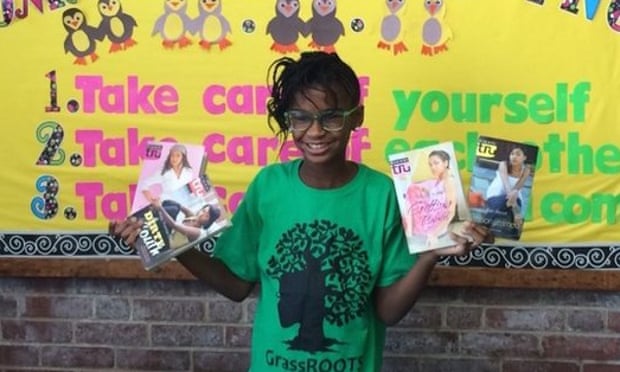
Marley Dias, with some of the #1000blackgirlbooks.
Marley Dias with some of her 1000 books
11-year-old Marley Dias, whose mother is from St. Mary, Jamaica, was frustrated with being given books to read about white boys and their dogs. Her mother, Janice Johnson Dias, asked her what she was going to do about it, so in November, Marley, with the help of her mother, launched a drive to collect 1000 Black Girl Books. 
          At Stacked Books, author and blogger Kelly Jensen raised nearly $3,000 in donations to help “this fabulous girl collect the books she wanted to meet her goal”, sending Dias a huge range of picture books, young adult titles and more.

Bookseller Barnes & Noble also donated books to the drive, saying that “some books introduce us to characters who are different from us, allowing us to see the world from a new perspective. But for children in the process of figuring out who they are, and who they want to be, it is just as important to also read stories about characters they can relate to, and see themselves in.”
Marley also appeared on US chat show Ellen, where she was given a laptop, and a cheque for $10,000 donated by Shutterfly. By February 9, 2016, she had reached her goal.
           This is an amazing achievement. Not only has Marley reached her goal, but she is also planning to donate the books to schools in the USA and to a library in St. Mary, Jamaica. I hope she will be coming in person to deliver these books and that she will get media coverage here.
       
   Marley’s drive highlights a problem. In the USA, where Kelly Jensen found that Black Girl Books were not as easily sourced, or prominently displayed as books about white children. When I first saw the hashtag “1000BlackGirlBooks”, I assumed that there were 1000 different titles, but that does not seem to have been the case. Kelly’s list included 45 picture books/early readers, 59 middle grade (8-12), 78 young adult (12-15), 16 Adult crossover, and 16 Graphic novels: total: 214.There was more than one copy of some books.
          In Jamaica, where at least 92% of the population is of African descent, the books available in bookshops and libraries do not reflect that. The bookshops display prominently books by Enid Blyton (1897 – 1968) considered to be racist by some people; Nancy Drew books; The Hardy Boys books; and The Diary of the Wimpy Kid, which is an-easy-to-read comic in book form and highly culture-bound. They don’t put Jamaican books on such prominent display (you have to search for them) and stock very few because, they say, “They don’t sell.” Who is buying these books? Mainly adults. Why are they not buying the Jamaican books? Because they don’t know about them. Diane Browne has written repeatedly about the need for Jamaican children to see themselves in books, but as Curdella Forbes pointed out  "Those who can afford to buy books have extensive options offered by the distributing giant Scholastic. With multiple outlets in the Caribbean, Scholastic leaves its local competitors far behind.” For lists of books by Jamaican authors, see my blog posts, for 8-12 year-olds and for younger children.
     The Jamaican Libraries, including school libraries, are mainly stocked by donations, so again the ethnicity and settings of these books don’t reflect the majority of the population and the Jamaican culture.  
      To be fair to the educational system and Ministry of Education, Jamaican and Caribbean books, including novels, plays and poetry, are on school book lists and on the CSEC  syllabus.
    
     Marley Dias is one in a million (many millions). I'm sure she won't mind us jumping on her band-wagon, and perhaps she will inspire Jamaican girls (and boys) to do something similar. But why is it, that up to now, children aren't asking for Jamaican books in book stores? Many of them never go into a book store or library. Of those who do, have they been brainwashed into thinking that there are no Jamaican authors and that only white people are heroes and heroines in books? And that it is more advantageous to have a white skin, hence the proliferation of bleaching? Perhaps Marley's drive can be a catalyst for change. Looking forward to hearing more about her.
Kelly Jensen’s list
Picture Books/Early Reader Title
  1. Abby by Jeannette Caines
  2. Anna, Banana, and The Big-Mouth Bet by Anica Mrose Rissi
  3. Anna, Banana, and The Friendship Split by Anica Mrose Rissi
  4. Anna, Banana, and The Monkey In The Middle by Anica Mrose Rissi
  5. Anna, Banana, and The Puppy Parade by Anica Mrose Rissi
  6. Anna Hibiscus (collection) by Atinuke
  7. Ballerina Dreams by Michaela DePrince*
  8. Black Mother Goose Book by Elizabeth Murphy Oliver
  9. Brown Angels: An Album of Pictures and Verse by Walter Dean Myers*
  10. Cassie’s Word Quilt by Faith Ringgold
  11. A Chair for My Mother by Vera B Williams
  12. Dancing in the Wings by Debbie Allen
  13. Don’t Call Me Grandma by Vaunda Nelson
  14. Ellington Was Not A Street by Ntozake Shange
  15. Firebird by Misty Copeland*
  16. The Granddaughter Necklace by Sharon Dennis Wyeth
  17. Her Stories: African American Folktales, Fairy Tales, and True Tales by Virginia Hamilton
  18. I Got The Rhythm by Connie Schofield-Morrison
  19. I’m A Pretty Little Black Girl by Betty K Bynum
  20. Jazz Age Josephine: Dancer, Singer, Who’s That, Who? Why That’s Miss Josephine Baker To You! by Jonah Winter*
  21. Josephine: The Dazzling Life of Josephine Baker by Patricia Hruby Powell*
  22. Keena Ford and the Field Trip Mixup by Melissa Thompson
  23. Let It Shine: Stories of Black Women Freedom Fighters by Andrea Davis Pinkney*
  24. Little Melba and Her Big Trombone by Katheryn Russell-Brown*
  25. The Little Piano Girl: The Story of Mary Lou Williams, Jazz Legend by Ann Ingalls*
  26. Mae Jemison: Biography by Jodie Shepherd*
  27. Molly by Golly: The Legend of Molly Williams, America’s First Female Firefighter by Dianne Ochiltree*
  28. Mufaro’s Beautiful Daughters: An African Tale by John Steptoe
  29. My Three Best Friends and Me, Zulay by Cari Best
  30. Hair Dance by Dinah Johnson*
  31. One Plastic Bag: Isatou Ceesay and the Recycling Women of the Gambia by Miranda Paul* http://www.amazon.com/One-Plastic-Bag-Recycling-Millbrook-ebook/dp/B00SG5YQ74/ref=sr_1_1?s=books&ie=UTF8&qid=1455138773&sr=1-1&keywords=one+plastic+bag+isatou+ceesay+and+the+recycling+women+of+the+gambia  
  32. One Word from Sophia by Jim Averbeck
  33. Pecan Pie Baby by Jacqueline Woodson
  34. Ruby and the Booker Boys #1: Brand New School, Brave New Ruby by Derrick Barnes
  35. Ruby and the Booker Boys #2: Trivia Queen, 3rd Grade Supreme by Derrick Barnes
  36. The Secret Olivia Told Me by N. Joy
  37. She Loved Baseball: The Effa Manley Story by Audrey Vernick*
  38. The Story of Ruby Bridges by Robert Coles
  39. Sugar Plum Ballerinas: Plum Fantastic by Whoopi Goldberg
  40. Sugar Plum Ballerinas: Toeshoe Trouble by Whoopi Goldberg
  41. Swing Sisters: The Story of the International Sweethearts of Rhythm by Karen Deans*
  42. Tar Beach by Faith Ringgold
  43. Voice of Freedom: Fanny Lou Hammer by Carole Boston Weatherford*
  44. Wangari Maathai: The Woman Who Planted Millions of Trees by Franck Prévot
  45. Wangari’s Trees of Peace by Jeanette Winter*


Middle Grade (some are higher level and some lower)

  1. Almost Zero by Nikki Grimes
  2. At Her Majesty’s Request: An African Princess in Victorian England by Walter Dean Myers*
  3. Bayou Magic by Jewel Parker Rhodes
  4. Bird by Crystal Chan
  5. brown girl dreaming by Jacqueline Woodson*
  6. Camo Girl by Kekla Magoon
  7. The Case of the Missing Museum Archives by Steve Brezenoff
  8. Celeste’s Harlem Renaissance by Eleanora E Tate
  9. Chains by Laurie Halse Anderson
  10. The Cheetah Girls by Deborah Gregory
  11. Ernestine and Amanda by Sandra Belton
  12. Feathers by Jacqueline Woodson
  13. The Freedom Maze by Delia Sherman
  14. Full Cicada Moon by Marilyn Hilton
  15. A Girl Named Disaster by Nancy Farmer
  16. Gone Crazy in Alabama by Rita Williams-Garcia
  17. Half-Way to Perfect by Nikki Grimes
  18. Hold Fast by Blue Balliett
  19. The Jumbies by Tracey Baptiste
  20. The Laura Line by Crystal Allen
  21. Leaving Gee’s Bend by Irene Latham
  22. Let The Circle Be Unbroken by Mildred D. Taylor
  23. Little Rock Girl 1957: How a Photograph Changed the Fight for Integration by Shelley Tougas*
  24. Ludell by Brenda Wilkinson
  25. The Magnificent Mya Tubbs: Spirit Week Showdown by Crystal Allen
  26. Make Way for Dyamonde Daniel by Nikki Grimes
  27. Maritcha: A Nineteenth Century American Girl by Tonya Bolden
  28. The Mighty Miss Malone by Christopher Paul Curtis
  29. Mo-Ne Davis: Remember My Name by Mo’ne Davis*
  30. Nikki and Deja by Karen English
  31. Nikki and Deja: Birthday Blues by Karen English
  32. Nikki and Deja: The Newsy News Newsletter by Karen English
  33. Nikki and Deja: Substitute Trouble by Karen English
  34. Ninth Ward by Jewell Parker Rhodes
  35. One Crazy Summer by Rita Williams-Garcia
  36. President of the Whole Fifth Grade by Sherri Winston
  37. President of the Whole Sixth Grade by Sherri Winston
  38. PS: Be Eleven by Rita Williams-Garcia
  39. The Red Pencil by Andrea Davis Pinkney
  40. The Road to Memphis by Mildred D. Taylor
  41. The Road to Paris by Nikki Grimes
  42. Roll of Thunder, Hear My Cry by Mildred D Taylor
  43. Searching for Sarah Rector: The Richest Black Girl in America by Tonya Bolden*
  44. Shadows of Sherwood by Kekla Magoon
  45. Silhouetted by the Blue by Traci L. Jones
  46. Skit Scat Raggedy Cat: Ella Fitzgerald by Roxane Orgill*
  47. Standing Against The Wind by Traci L Jones
  48. Sugar by Jewell Parker Rhodes
  49. Twintuition: Double Vision by Tia and Tamara Mowry
  50. The True Meaning of Smekday by Adam Rex
  51. Unstoppable Octabia May by Sharon Flake
  52. Who Was Harriet Tubman? by Yona Zeldis McDonough*
  53. Who Was Maya Angelou? by Ellen Labrecque*
  54. Who Was Michelle Obama? by Megan Stein*
  55. Who Was Rosa Parks? by Yona Zeldis McDonough*
  56. Who Was Sojourner Truth? by Yona Zeldis McDonough*
  57. Words With Wings by Nikki Grimes
  58. Zahrah The Windseeker by Nnedi Okorafor-Mbachu
  59. Zora and Me by Victoria Bond


Young Adult

  1. 16 1/2 on the Block by Babygirl Daniels
  2. Akata Witch by Nnedi Okorafor
  3. Black Beauty by Constance Burris
  4. Black, White, Other: In Search of Nina Armstrong by Joan Steinau Lester
  5. Blessings in Disguise by ReShonda Tate Billingsley
  6. Boy Trouble by ReShonda Tate Billingsley
  7. Burning Emerald by Jaime Reed
  8. Caught Up by Amir Abrams
  9. A Certain October by Angela Johnson
  10. The Chaos by Nalo Hopkinson
  11. Claudette Colvin: Twice Toward Justice by Phillip Hoose
  12. Cleo Edison Oliver, Playground Millionaire by Sundee T Frazier
  13. Coffee Will Make You Black by April Sinclair
  14. Copper Sun by Sharon Draper
  15. Court of Fives by Kate Elliott
  16. Don’t Fail Me Now by Una LaMarche
  17. The Ear, The Eye, and The Arm by Nancy Farmer
  18. Endangered by Lamar Giles
  19. Everything Everything by Nicola Yoon
  20. Eye Candy by ReShonda Tate Billingsley
  21. Fading Amber by Jaime Reed
  22. Finding My Place by Traci L. Jones
  23. Fire From The Rock by Sharon Draper
  24. Fire in the Streets by Kekla Magoon
  25. Flipping the Script by Paula Chase
  26. Flygirl by Sherri L Smith
  27. Friends ’til The End by ReShonda Tate Billingsley
  28. Get Ready for War by ReShonda Tate Billingsley
  29. Getting Even by ReShonda Tate Billingsley
  30. Glitter by Babygirl Daniels
  31. The Good Braider by Terry Farish
  32. Heaven by Angela Johnson
  33. Hidden by Helen Frost
  34. High School High by Shannon Freeman
  35. Hollywood High by Ni-Ni Simone
  36. The House You Pass On The Way by Jacqueline Woodson
  37. How I Discovered Poetry by Marilyn Nelson
  38. I Hadn’t Meant to Tell You This by Jacqueline Woodson
  39. Jumped by Rita Garcia Williams
  40. Kendra by Coe Booth
  41. Liar by Justine Larbalestier
  42. Lights, Love, and Lip Gloss by Ni-Ni Simone
  43. Living Violet by Jaime Reed
  44. Lost Girl Found by Leah Bassoff
  45. Love is the Drug by Alaya Dawn Johnson
  46. Magic Under Glass by Jaclyn Dolamore
  47. Magic Under Stone by Jaclyn Dolamore
  48. Mare’s War by Tanita S Davis
  49. Not Otherwise Specified by Hannah Moskowitz
  50. Nothing But Drama by ReShonda Tate Billingsley
  51. Orleans by Sherri L Smith
  52. Peas and Carrots by Tanita S. Davis
  53. Pinned by Sharon Flake
  54. Pointe by Brandy Colbert
  55. Put Your Diamonds Up by Ni-Ni Simone
  56. Real As It Gets by ReShonda Tate Billingsley
  57. The Return by Sonia Levitin
  58. Rumor Central by ReShonda Tate Billingsley
  59. See No Color by Shannon Gibney
  60. Servants of the Storm by Delilah S Dawson
  61. Shadowshaper by Daniel José Older
  62. Sister Sister by Babygirl Daniels
  63. Slice of Cherry by Dia Reeves
  64. Something Like Hope by Shawn Goodman
  65. Sound by Alexandra Duncan
  66. The Summer of Chasing Mermaids by Sarah Ockler
  67. The Summer Prince by Alaya Dawn Johnson
  68. Taking Flight by Michaela DePrince and Elaine DePrince*
  69. Tankborn by Karen Sandler
  70. That’s What’s Up by Paula Chase
  71. This Side of Home by Renée Watson
  72. Tiny Pretty Things by Sona Charaipotra and Dhonielle Clayton
  73. Toning The Sweep by Angela Johnson
  74. Truth or Dare by ReShonda Tate Billingsley
  75. Under A Painted Sky by Stacey Lee
  76. Who You Wit’ by Paula Chase
  77. A Wish After Midnight by Zetta Elliott
  78. You Don’t Know Me Like That by ReShonda Tate Billingsley


Adult (with crossover appeal)

  1. African American Women from the National Museum of African American History and Culture*
  2. The Best of All Possible Worlds by Karen Lord
  3. Black Girl in Paris by Shay Youngblood
  4. Brown Girl In The Ring by Nalo Hopkinson
  5. The Color Purple by Alice Walker
  6. Composition in Black and White: The Life of Philippa Schuyler by Kathryn Talalay
  7. I Know Why The Caged Bird Sings by Maya Angelou
  8. Kindred by Octavia Butler
  9. Life in Motion by Misty Copeland*
  10. The Misadventures of Awkward Black Girl by Issa Rae*
  11. Misty Copeland: Power and Grace by Richard Corman*
  12. Tears for Water by Alicia Keyes*
  13. The Hundred Thousand Kingdoms by NK Jemisin
  14. The Shadowed Sun by NK Jemisin
  15. Their Eyes Were Watching God by Zora Neale Hurston
  16. We Should All Be Feminists by Chimamanda Ngozi Adichie*


Graphic Novels

  1. Abina and the Important Men by Trevor R Getz
  2. Akissi: Feline Invasion by Marguerite Abouet
  3. Astonishing X-Men: Ororo — Before The Storm by Mark Sumerak
  4. Aya: Life in Yop City by Marguerite Aboulet
  5. Aya: Love in Yop City by Marguerite Aboulet
  6. Fight Like A Girl: Learning Curve by David Pinckney
  7. Infinity Gauntlet: Warzones by Gerry Duggan
  8. Little Robot by Ben Hatke
  9. Malice in Ovenland by Micheline Hess
  10. The Many Adventures of Miranda Mercury: Time Runs Out by Brandon Thomas
  11. Ororo: Before The Storm 1 by Marc Sumerak
  12. Princeless: Be Yourself by Jeremy Whitley
  13. Princeless: The Pirate Princess by Jeremy Whitley
  14. Princeless: Save Yourself by Jeremy Whitley
  15. Princeless: Get Over Yourself by Jeremy Whitley
  16. Vixen: Return of the Lion by G. Willow Wilson


Tuesday, February 2, 2016

Book Reading at Hanover Parish Library

It’s been a while since I did a book reading, so I was keen to take up Marvetta Stewart Richard’s invitation to read from Delroy in the Marog Kingdom, at Hanover Parish Library, on Friday January 29, 2016. As we had arranged for 11 o’clock, I was impressed when Michelle Deacon-Brown, Children’s Services Librarian, who greeted me, said that the children were ready and waiting. Indeed they were, waiting patiently. I learned, to my delight, that the students were from Hanover Preparatory School, the successor to Lucea Prep which I had founded in 1982. What was more, the principal, Desiree Brissett, remembered that I had been on the staff at Rusea’s High School when she was a student there!
         I started my reading in the usual way with a boy playing the part of Delroy, putting the frog in the pot and another boy clamping on the lid. When I read “I stifled the urge to burst out laughing,” the boy acting as Delroy didn’t stifle the urge at all, much to everyone’s amusement. I later found out that this boy is an avid reader, reading up to 8 books a week.
The frog who takes part in my
book readings.

I appreciated the quiet venue of the library, unlike some of the schools where I have read, where I’ve hardly been able to hear my own voice.  All the students, being able to hear, were attentive and appreciative. The vote of thanks was given by Michaela Harvey, the Hanover Spelling Bee Champion.
After the reading, Mrs. Deacon-Brown told me of some of the initiatives she takes to encourage children to read. There is  a book club which meets every Friday afternoon. The library staff help children to choose their books and challenge the better readers to try more difficult books. If they don't like them, there's no pressure on them to read them.


They have a section for Jamaican (local) books which they encourage children to read. There were well-worn copies of Miss Bettina's House by Hazel Campbell, Jenny and the General by Jean D'Costa, and other books in Carlong's Sand Pebble Series.   Hopefully, the empty shelves mean that most of the books, including 'Delroy in the Marog Kingdom', are out on loan! Whether that is so or not, the library with its limited budget would benefit from donations of more of these books.
To instill a love of books in children from an early age, there is a section for tiny tots where their mothers can read to them in a child-friendly atmosphere. More mothers need to take advantage of this space. In addition to the Parish Library in Lucea, there are branch libraries in Chester Castle, Pondside, Askenish, Jericho and Hopewell. There is also a Bookmobile. Are the communities they serve taking full advantage of  what is being offered?  The best way for children to improve their reading is to read widely. Mrs. Stewart Richards, Mrs. Deacon Brown are doing a great job in making books available to children. They deserve our support.

Room for tiny  tots and their mothers


Wednesday, January 20, 2016

Mosquitoes for Science Projects in Schools

     
The chikungunya outbreak and now the threat of Zika in Jamaica, and the comments about mosquitoes by callers to talk-shows made me aware that much of the ignorance exposed could be addressed by students doing science projects on mosquitoes, with primary research in addition to research on the internet.

There are more than 3,000 species of mosquito world-wide and over 50 in Jamaica. The identification of species is highly technical and carried out by a limited number of persons. However, at the primary school level, children can observe and classify a few species.
Male Aedes with
feathery antennae
For example, all children would be familiar with the Aedes aegypti, which is active during the day, has white stripes on its legs, and breeds in small amounts of water. Other children will be familiar with species which breed in swamps and swarm at dusk, and are bigger than Aedes. The mosquito which transmits malaria, Anopheles, is longer and thinner and rests with its two hind legs in mid- air. Perhaps children are also able to detect a difference in the sounds made by these mosquitoes. It should be pointed out that, although there are some disease carrying species, mosquitoes serve useful purposes as pollinators, as food for bats (who are pollinators and aid in seed dispersal), as food for frogs, lizards and birds, and in their larval stages as food for fish and larval amphibians. Research on mosquitoes is carried out at the Windsor Research Centre in the Cockpit Country. http://www.jamaicaobserver.com/environment/Meet-the-mosquitoes_15093379

In the USA, much research is carried out on mosquitoes and suggestions for school projects are described on Clark University’s website.
 The following projects are suitable for biology students taking external exams at end of Grade 11 and higher. They require patience and persistence. It would be helpful is hand lenses and binocular microscopes were available.
A project could proceed as follows :

1.               choose an investigation

2.               conduct background research

3.               list materials needed

4.               list steps involved

5.               estimate the time involved

6.               set up the investigation

7.               collect and record data

8.               analyse data and draw conclusions

9.               present data to the class or school

Example  
Aedes  - male to left,
female in center

1.               To investigate the life cycle of Aedes aegypti.
2.               Background research: Reading.
           
3. Materials: jar containing water with a piece of dead leaf (about 1 cm sq. ) in it/
 
4.               Steps: Place the jar in places frequented by mosquitoes, and observe daily. When eggs are seen inside the jar, just above the water line, add water to cover the eggs. Take the jar to where they can be observed easily (out of the sun).

5.               Time: 7 to 10 days.

6.               Set up experiment.

7.               Record when the eggs hatch and when the larvae moult. When the larvae become pupae (comma-shaped), cover the jar, to prevent adult mosquitoes escaping. A hand lens would be useful to observe the eggs and the young larvae.

8.               Analyze findings: Did observations correspond with background research?

9.               Present findings to the class.

Suggestions for other projects:

1.     Do Aedes mosquitoes show preferences for

a)     Jars set up in the shade or in the sun?

b)     Jars with dead leaves in them or without dead leaves?

c)     Water with or without food coloring? (use different colors).

2.     What attracts Aedes mosquitoes to people? If students let out the mosquitoes from the above experiments in a fish tank with a tightly fitting mesh cover, they could try the following, being careful not to let out the mosquitoes

a)     Temperature – fill some balloons with warm and others with cold water.

b)     Color – use different colored balloons.

c)     Gases – carbon dioxide from fermentation using yeast; oxygen from hydrogen peroxide.

 
3.     Survey of persons who had chikungunya. Each child can conduct a survey in their community. Did everyone in the household catch it? Make a map showing where these persons are located. Do they believe that ChikV is transmitted by mosquitoes? Analyze arguments for and against this.
4. What is the effectiveness of different mosquito repellants? Design an experiment to find out.

             For primary school children, a more straightforward project would be to investigate where mosquitoes breed, by searching for mosquito larvae in discarded containers and old tyres. The larvae are most likely to be the final stage before they become pupae. These breeding sites should be destroyed after collecting some of the larvae.These can be put in a glass jar in order to observe when they become pupae and then adults. The jars should be  covered to prevent the adults from escaping. How they could be disposed of is a topic for discussion.


Sunday, November 29, 2015

Closing the GSAT Gap


Library at Kendal Primary, ranked 5th in GSAT
in Hanover. Great Shape Inc donated many books
and assisted teachers at this school.
“Close GSAT Gap” was the headline in the Gleaner on Nov 24, 2015, the gap being between the high rankings of the Prep Schools and lower ranking of the Primary Schools. I would first question the reality of this gap, because the scores for the schools are based on the average score for all children taking GSAT in that school. If you considered only the top half of the entrants (for example the top 3 streams in a 6 stream school) in a selected primary school, you might well get scores comparable to those of the prep schools. The primary schools have no choice but to enter all the children who pass the grade 4 Literacy and Numeracy Tests. The numbers of entrants from some of these primary schools far exceed the numbers form any prep school; for example 257 from Corinaldi Avenue Primary and 251 from Mandeville Primary and Junior High. The prep schools are less likely to have as many poorly performing students, partly because the parents of prep school children are paying high fees and do everything they can to make sure their children get high scores.
The article implied that the prep schools are

In Mount Alvernia Prep Library, presenting copies of
Delroy in the Marog Kingdom, donated by past students.
performing very much better than the primary schools; and that the principal and staff of prep schools are in a position to advise the principals of the primary schools. If the principals of the prep schools took over the primary schools, I doubt if there would be any improvement in performance, given the environment and resources of the primary schools. The GSAT Gaps I am more concerned about are the gap between the performance of boys and girls; (it would be interesting to know the extent of the gender gap in prep schools) ; the gap between the best and worst performing students of any school; and the gap between urban schools (urban here meaning all urban centres, not just Kingston) and rural schools.
 In the GSAT Ranking supplement of the same day there were ‘Edu’ quotes. I select 2 of them which I think have a strong bearing on the GSAT Gaps.
1st quote from Maya Angelou: “My mother said I must always be intolerant of ignorance but understanding of illiteracy. That some people, unable to go to school, were more educated and more intelligent than college professors.”
Buckingham Primary, a rural school
There are many people who do not see illiteracy as an impediment to advancing in life, and are skeptical of the advantages of education. They know of educated people, including trained teachers and others with university degrees unable to find jobs.  The children of farmers are extra pairs of hands, and are often taken out of school when they reach the age when they can be helpful. In urban areas, boys are sent out to hustle. Other young people get involved in criminal activities, such as ganja growing and ‘scamming’ which they consider to be legitimate means of earning a living. These attitudes are transmitted to school children whose parents don’t insist on regular attendance, punctuality or doing homework.
2nd quote from William Temple: “The most influential of all educational factors is the conversation in a child’s home.”
This is true all over the world. Studies have shown that 6-year-old children of educated parents have a wider vocabulary and a better command of language than those of less well educated parents. In Jamaica we have the added complication of having two languages. For many children, creole or patois is their only language until they start going to school. When they start learning to read, they have to make an abrupt shift to the unfamiliar syntax of Standard Jamaican English (SJE). They are also encouraged to speak this language at school, reinforced by numerous exercises in writing grammatically correct English. There is resentment against this in some quarters, English being the language of the former slave-masters and the present-day upper classes. As a result, children perform poorly, because all school subjects require competence in SJE. The children who attend prep schools are more likely to be fluent in both SJE and patois, so do not encounter the same difficulties or negative attitudes to SJE. 
I don’t think that the school communities of prep schools would be in a position to address either the language or the attitude barriers to improved performance in GSAT. What could make a difference?
In relation to attitude, there need to be more employment opportunities together with a campaign to inform people about the qualifications needed for these jobs. Politicians are fond of announcing “Jobs, jobs, jobs,” but fail to tell people they will need CSEC English to fill many of these jobs; and that preparation for CSEC English begins in Grade 1 of the primary schools!
In relation to the language dilemma, I submit that children should be taught to read, and have their early teaching in Jamaican creole. This suggestion has been made before and research has been carried out in several countries where a creole is spoken. I quote from an article ‘Creole Speakers and Standard Language Education’, by Gillian Wigglesworth et al, in the Language and Linguistics Compass 7/7 (2013):
“However, Siegel  points out that while there is very limited research on the use of creoles in education, the positive benefits are clear and include increased motivation and improvement in the standard variety as well as improvement in overall academic performance. He also notes that none of the studies in this area show any negative effects.
The benefits of beginning schooling in a child’s home language are well documented."
In Aruba, Papiamento, a creole which has its origins in African languages and Portuguese, replaced Dutch as the official language in 2003. Aruba has one of the highest standards of living and lowest unemployment rates in the Caribbean region. In addition to speaking Papiamento, many people there are fluent in Spanish, English and Dutch,
 Here in Jamaica, Hubert Devonish, Professor of Linguistics at UWI, one of the strongest advocates fighting for Jamaican Patois as a language. He carried out a study in a primary school, teaching the children from grades 1-4 in both patois and SJE. The children, especially the boys, performed better than average in this programme. Teaching in patois could also help to close the gap in performance between boys and girls. Although the results of this study are gathering dust on the shelves in the Ministry of Education, Professor Devonish is confident that Jamaican Creole will become one of the official languages of Jamaica. He carried out a survey in which he found that 70% of the population would be in favour of this. However, there are many Jamaicans who have a negative attitude towards patois.
Georgene Growe (r) donated Delroy in the Marog Kingsom to
the Principal of Kendal Primary School. At left,Gretchen Lee,
a volunteer organizer with Great Shape Inc.
Giving children more access to books for them to read for pleasure would be another way of closing the GSAT gaps. It has been shown that children who read regularly (about 40 books a year) for pleasure perform better in all subject areas than children who read very little. The average prep school child is more likely than the average primary school child. to be an avid reader. Only a small percentage of children make frequent visits to their local libraries, and school libraries vary considerably in their usefulness. Class libraries stocked with enough books at the reading levels of all the children in the class would go a far way towards meeting this need, as I explained in my blog post of September 23, 2014 "How to Help Kids Become Skilled, Passionate, Habitual, Critical Readers". "A class Library Movement" would require funding, but more than that would require the will and the understanding of teachers and parents to make it work. Past students could also be asked to  donate books for class libraries.
So that is my wish-list for closing the GSAT Gaps: a desire for education throughout the population; the teaching of children in Jamaican Creole; and Class Libraries for every class in every school. In the future these libraries would have in them books written in Jamaican Creole and illustrated by Jamaicans!


Thursday, November 12, 2015

Ash the Flash - A Book Review


If you're like me, you sometimes scan the first few lines of an article, planning to return to it later, but then that doesn't happen. So, in my first few lines, I appeal to parents and all those who buy books for 10-12 year-old Jamaican children, ask for "Ash the Flash" at any Sangsters Bookstore. Teachers and librarians, please recommend this book. Although the number of books about Jamaican children by Jamaican authors is growing, they are not always the first choice of those who recommend books for children. Research has demonstrated the importance of children identifying themselves in at least some of the books they read. "Ash the Flash" and other books in the Sand Pebbles Series are a good starting point.
Those who follow Hazel Campbell’s Facebook page will know that she is an ardent supporter of our athletes and she also lightens up our day with jokes. She has combined these two aspects of her personality in the most recent book in Carlong Publishers Pleasure Series, “Ash the Flash”. It is co-authored by Nattalie Gordon. I don’t know how these two ladies wrote this book together*, but the result is a seamless read.
Carlong describes the book as follows:
In this story, every boy's fantasy comes alive for Ashton Longmore when he finds himself able to run at unbelievable speeds. He can run faster than Usain Bolt! He can run so fast he is only a blur on the field. How did this happen? Where will this lead him? Can he control the speed so he is not labelled a freak ... or worse? Can he use this speed to get victory at the athletic meet for his school? His best friend, Kenroi Donaldson, tries to help him manage this gift and they get into several exciting situations along the way. When they realize that the gift is waning, and there is a strong possibility that he might not win against the rival school's superstar at an important meet, Ash has to summon all his natural strength to prove to himself that he can win and make his school and father proud.
The Key features of this book are:
Although seemingly realistic, this story falls under the genre of fantasy as the incident which started the events in the story is unreal. There is a brief note in the introduction to explain this to readers.
  • The language of the story is mostly Standard English often in the more informal style used and easily understood by the age group.
  • The story places emphasis on an individual's growth towards making the right moral decisions.
  • The main characters in the story are boys as it is aimed at encouraging boys to read. This is a boy-to-enjoy book. Girls will enjoy it too.
  • The characters are well drawn, likeable, and representative of experiences in Grade 6.
  • The setting - school and especially athletic meets - is a popular one today.
  • The story shows both the strengths and weaknesses of friendship as Kenroi tries to influence Ashton's choices.
  • The all important message about the danger of taking drugs to enhance performance is not hammered but gradually revealed as the story progresses.
  • This book is an excellent choice for supplementary reading in schools or at home.
All this information about the book make it attractive to teachers, parents and librarians. What it doesn’t say is why it will most likely appeal to children -  the story is amusingly written. Bizarre situations are described in a dead-pan voice; and mundane events have comical twists. Furthermore,the children in the story, although  mischievous, come across as balanced, normal, sensible and devoid of any hang-ups; while the adults’ personalities are flawed. Uncle Norman is a wacky chemistry teacher, who loves to experiment. Ashton’s father is still bitter about the fact that, twenty years before, another boy had been selected instead of him to run for Jamaica. He is disappointed that up to now, Ashton had shown no interest in athletics. The third adult in the story, as a boy, had been Ashton’s father’s nemesis.  He will go to any length to make sure that his own son follows in his footsteps. It is this portrayal of the characters which will make the book captivating to the 10-12 year-olds for whom it is written.

About the authors
 Hazel D. Campbell
has written and edited stories for children and has produced children's programmes for radio and television. She teaches story writing for children at the UWI. She is the recipient of the 1997 Vic Reid Award for Children's Literature. She is also the series editor for Carlong's Sand Pebbles Pleasure Series for children.
Link to Hazel's blog post about her other books.


Nattalie Gordon
is the 2010 winner of the National Reading Competition and a multiple-time entrant and awardee in the Jamaica Cultural Development Commission's (JCDC) Creative Writing Competition. In 2013 she won two gold medals in the competition.


*See Hazel's comment about how they worked together.

Thursday, November 5, 2015

My Most Popular Posts


To have an internet presence, writers are advised to post weekly in a blog, and to be active on Facebook and Twitter. I found it impossible to keep up with weekly blog posts. In fact in 2013, I took a 6-month break from blogging to concentrate on writing “The Last of the Marogs”. I was surprised to find that people continued to visit my blog and that some posts, written as far back as 2012, continue to be popular.
The 6 most popular are:
3.     GSATRanking and School Size (February 2014) 
4.     Books for Children by Jamaican Authors. I updated this post in August 2014. 
5.     Island Princess in Brooklyn (March 2012) This is a review of Diane Browne's book and an account of my reading of it at St. James Parish Library
 6.     Dyslexia  (February 2012)

 I target Jamaican readers in my posts but see that there is an audience for them in the Ukraine and Russia as well as Germany, France, the UK and the USA.
 Among the posts I would particularly like Jamaicans to read are:
  1. Guest Blog with Natalie Bennett  on the Granville Summer Programme. (July 2012)
  2. Dangers of Smoke and Smoking (August 2013)

  3. Thank you to my readers who have commented on my posts, and to those who have expressed appreciation. You encourage me to continue posting to promote the value and joys of literacy.