Showing posts with label books for children. Show all posts

Saturday, April 4, 2015

Children's Books from or about Africa


This is the first of a series of posts I am writing for persons who would like to purchase multicultural books for Jamaican children, and would appreciate suggestions about what is available and appropriate. I hope that this list will also be useful for teachers, librarians, book distributers and corporate donors. This post has 20 books from and about Africa. I have been somewhat arbitrary in my selection, mainly from the website of Africa Access Review. One post cannot cover this vast continent, so there will be a part 2 at some point.
The first 10 books on the list are for younger children (aged 4-7), but not for them to read on their own, because of the level of vocabulary, the sentence structure and the concepts. They are, however, ideal for reading aloud and for discussion.    

1.     Ais for Africa by Ifeoma Onyefulu (Puffin Books 1997)  – good information about Nigeria, suitable for Jamaican Basic Schools.  Ifeoma Onyefulu has written many more beautifully illustrated books for this age group.
2.     The Magic Gourd by Baba Wague Diakite (Scholastic 2003)  - a folktale from Mali about kindness and generosity. Good for reading aloud to 4 – 7 year-olds. 
3.     A Gift from Childhood by Baba Wague Diakite (Groundwood Books 2010) - a story about traditional village life in Mali. 
4.     KenteColors by Debbi Chocolate (Walker Children’s 1997) - about the traditional kente cloth of the Ashante people of Ghana  
5.     Handa’s Hen by Eileen Browne (Candlewick 2011) – a simple counting story set in Kenya.   
6.     Catch That Goat by Polly Alakija (Barefoot Books 2002) – set in Nigeria, a goat gets away and runs through the town’s market. Grade 1 children should be able to read this simple story on their own. Younger children could tell the story from the illustrations.
7.     Babu’s Song by Stephanie Stuve-Bodeen (Lee and Low Books 2003) – with the help of Babu, his mute grandfather, Bernard is able to go to school.
8.     Muktar and the Camels by Janet Graber (Henry Holt and Co 2009) – living in an orphanage on the border of Somalia and Kenya, Muktar remembers the time when he lived with his family and the camels.  This book would also be of interest to older children who could read it for themselves. 
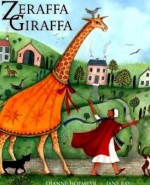
9.     Zeraffa Giraffa by Quarto Generic (Frances Lincoln Children’s Books 2014) – the amazing  true story of  Zeraffa, a giraffe who was sent as a gift by the Ottoman Viceroy of Egypt to King Charles X of France in 1826. 
10.  Circle Unbroken by Margo Theis Raven (Square Fish 2007) – the story of how the art of basket-making was taken from Africa to the Carolinas. Is there a similar story of the way in which the art of basket-making was brought to Jamaica?  


   The following 10 books are suitable for children aged 8-12 to read on their own.
1.     Sundiata:Lion King of Mali by David Wisniewski. (HMH Books for Young Readers; 1999) In the thirteenth century, Sundiata overcame physical handicaps, social disgrace, and strong opposition to rule the West African trading empire of Mali. A good book for teachers to read aloud to grades 2 & 3 children, and for older children to read on their own. 
2.     The Other Side of Truth by Beverley Naidoo (Harper Trophy 2002) – 2 children are smuggled out of Nigeria when their mother is killed in political unrest. The difficulties they face as refugees in London.  This story won a Carnegie Medal UK and many other awards.  
3.    Nelson Mandela The Long Walk to Freedom by Chris Van Wyk and Nelson Mandela (Macmillan 2009) – an abridged version of Nelson Mandela’s autobiography. 
4.     The No.1 Car Spotter by Atinuke  (Kane Miller Book Pub; June 2011) – No 1 is bright, plucky and resourceful – a fantastic character for Atinuke’s new series
5.     How the Leopard got his Claws by Chinua Achebe (Candlewick Press 2011)  – a fable about the dangers of power taken by force.
6.     The Boy Who Harnessed the Wind by William Kamkwamba (Dial Books for Young Readers 2012)the true story of how this author, as a teenager, built a functional windmill from junkyard scraps in Malawi.  
7.     Pharoah’s Boat by David Weitzman (Houghton Mifflin Books for Children 2009) - the story of how one of the greatest boats of ancient Egypt came to be built.
8.     Seeds of Change – Planting a Path to Peace by Jen Johnson (Lee and Low Books 2010) - tree planting movement in Kenya spearheaded by Wangari Maathai and other women, and opposed by government and multinationals. 
9.     Bintou’s Braids by Sylviane Diouf  (Chronicle Books 2001)– a young girl in West Africa is in a hurry to grow up, but she learns that she must earn her braids. 
10.  Mystery of MeerkatHill by Alexander McCall Smith (Anchor 2013) – one of several children’s detective stories, about Precious Ramotswe, set in Botswana. 

Wednesday, October 1, 2014

Suggestions for books for 3-6 year-olds

Following my post of Sep 23, 2014, on How to Help Kids Become Skilled, Passionate, Habitual, Critical Readers, I'm making suggestions about appropriate books for children to choose from. They can learn to love books from as early as Kindergarten/ Basic School. The purpose of this post is to be a guide to parents, teachers and well-wishers of Jamaican children aged 3-6 in Basic Schools and Kindergartens, who would like to buy books for children but don't know where to begin. See also my blog of March 1, 2014 for books by Jamaican authors for young children.  I used the list of books recommended by children, on CTL's website to find many of the others. Because most of the authors listed live in the USA, and have a bias towards that culture, I haven't recommended books about baseball, football, or the seasons, especially winter and snow which Jamaican children are unlikely to have experienced. I've highlighted one book per author, but together they have hundreds of other books in print.
A comment here about reading: reading means gaining meaning from words and from pictures. The illustrations in children's books are equally as important as the words.  Children build some key reading skills when they read wordless books, or books with very few words. These include comprehension, sequencing, inferring, predicting and reading from left to right and top to bottom in English.  Many of the books listed are for fluent readers to read aloud to children. The importance of reading aloud,  and for the children then to have the books in their hands, cannot be overemphasized.
Authors are listed in alphabetical order.

1. Atinuke and Lauren Tobia: Anna Hibiscus Series, set in modern Nigeria. Delightful books for the enlightenment of people not living in Nigeria, and for the entertainment of those living there.

2. Molly Bang:  When Sophie Gets Angry . Sophie gets really angry but has her own way of calming down. Minimal text, but the pictures also tell the story.
There are several other titles by this author.

3. Eric Carle: The Very Hungry Caterpillar. In this children's classic, the caterpillar eats his way through the book.  A teacher or parent would need to read this to younger children, but there's plenty of room for discussion along the way. Eric Carle has over forty children's books in print.


4. Donald Crews: Flying Minimal text. Children would need guidance the first time they look at this book, but afterwards would be able to 'read' the story on their own by looking at the pictures. Donald Crew has many books about transport, including Truck which is a wordless book. Useful in Jamaican basic schools, except for the setting which of course is in the USA.

5. Lois Ehlert: Top Cat . Top Cat rules the house until a new kitten arrives. At first he doesn't want to share but then finds that 2 can be more fun than one. The text is in large print but the vocabulary is beyond most basic school children. Suitable for read-aloud and discussion.
Lois Ehlert has written and illustrated more than 25 children's books, many of them about the natural environment in the USA, so the birds and plants she mentions would not be familiar to Jamaican children.

6. Ed Emberley: Go Away, Big Green Monster! Kids can turn the pages and watch the monster grow then disappear. Pictures provide clues for the simple text.
 Ed Emberley is the author and illustrator of over 80 books.

7. Ian Falconer: Olivia Have fun with Olivia, dressing up, singing songs and wearing people out. Pre-readers can 'read' a story from the delightful pictures, and, with some help, the text is manageable for emergent readers.
Ian Falconer has written and illustrated 10 more Olivia books.

8. Denise Fleming: In the Tall, Tall Grass  - what a caterpillar would see. A few words of simple text in large letters on each page. Children would soon learn to recognize these words. I would like to see this book in every basic school in Jamaica.
Denise Fleming is the author and illustrator of 15 picture books.

9. Mem Fox: Koala Lou A delightful book for parents or teachers to read aloud to younger children and for older children to read for themselves.
Mem Fox had written dozens of children's books and promotes literacy. She gives good advice in her 10 commandments for reading aloud.     

10. Kevin Henkes: Chrysanthemum Text good for reading aloud and discussion.
Kevin Henkes is the author and illustrator of close to 50 picture books.

11. Jarrett J. Krosoczka: Peanut Butter and Jellyfish - a story of friendship. This is another read-aloud book, but non-readers, after hearing it, would be able to tell the story from the pictures.

12. Bill Martin, Jr.:  Chicka Chicka Boom Boom - the letters of the alphabet race one another to the top of the coconut tree. Another book I would like every basic school to have. The rhythmic text would soon be memorized by children. It is available as a board book which would prolong its life when handled by
children. I also recommend Chicka Chicka 1 2 3, by the same author.

13. Jerry Pinkney: The Lion and the Mouse and The Tortoise and the Hare  Children who are struggling with letter recognition can successfully read well-known fables in these two beautifully illustrated wordless books.

14. David Shannon: No, David  I say 'yes' to this book, which highlights all the things David mustn't do. "No, David" is written on every page. There are other suitable books by this author illustrator.

15. Rosemary Wells: Yoko  Yet another read-aloud book, but I included it because of its cultural diversity. Although Yoko is disguised here as a cat, from her name and the text she is unmistakably Japanese. Rosemarie Wells has written other books
about Yoko which would also be well-worth purchasing.

16. Mo Willems: Don't let the Pigeon Drive the Bus  Teachers, when you read this book to children, they will answer the questions! As children become more fluent readers they will be able to read the simple text for themselves. There are several more pigeon books.

My final comment is a plea to make more books available to Jamaican children, especially in Basic Schools. If you are Jamaican, living abroad, paying a visit to Jamaica, why not purchase a few of these books to donate to a Basic School near to where you will be staying?


Tuesday, September 23, 2014

How to Help Kids become Skilled, Passionate, Habitual, Critical Readers

You don’t often hear of a non-fiction book being hard to put down, and pulling at your heart strings, but that was my experience with “The Reading Zone – HOW TO HELP KIDS BECOME SKILLED, PASSIONATE, HABITUAL, CRITICAL READERS ” by Nancie Atwell, which endorsed for me what I have always taken for granted – the value of reading.
My mother used to read to us from as far back as I can remember – Beatrix Potter stories, Alison Uttley’s ‘Little Grey Rabbit’, The Wind in the Willows, Arthur Ransome’s ‘Swallows and Amazons’ series. But she had a harder time turning me into a skilled, passionate, habitual, critical reader. Unlike my sister, I wasn’t too keen on the titles my mother picked out for me. I suspect that they were above my reading level at
My mother read this to me!
the time and that I wasn’t interested in the content. I liked to read stories by Enid Blyton, whom my parents regarded as sexist and racist. I was oblivious of this, although I knew they didn’t like her books. They weren’t in favour of comics either, probably sharing the view of The 
Reverend John Marcus Harston Morris who “decried the violence and sensationalism of American crime and horror comics and their effects on British children”,  and who started his own comic, “Eagle”, which they allowed us to read. I don’t remember being captivated by Dan Dare or space travel as a result. I’m still not keen on books about exploring the universe. The books that turned me into a reader were C.S. Forester’s “Hornblower” Series. I also enjoyed historical novels for children by Geoffrey Trease. I have a vague recollection of his making a visit to our school and being disappointed by his appearance and lack-luster presentation.
When it came time for me to read to my own children, many more titles were available than when I was child. Favourites were the “Ant and Bee” books and “What a Mess” by Frank Muir. I started Lucea Prep School in 1982, when there was no internet or Amazon, but that didn’t stop me from getting books. Because of the limited range in the local bookshops, I chose books from the Scholastic catalogue to build up a school library. I encouraged parents to buy books, too, but there was often a distressing delay in getting the books by post. I also borrowed books from Hanover Parish Library to read to the children.

Atwell’s premise, I had seen in other writings before, is that
“frequent voluminous reading is the single activity that consistently correlates with high levels of performance in standardized tests of reading ability.” She follows this up with real life examples of how frequent voluminous reading is achieved in her school, Center for Teaching and Learning (CTL) Edgecomb, Maine, where “teachers hope that along the way students will become smarter, happier, more just and compassionate people because of the worlds they experience in books.” Doesn’t that describe what we would like our students to become in Jamaica? Atwell says “The only surefire way to induce a love of books is to invite students to select their own.” And “…free choice of books should be a young reader’s right, not a privilege.”  “When kids are reading stories that are interesting to them, when books are written at their independent reading levels, comprehension is direct, they understand.” They don’t have to be taught ‘comprehension’.
Most of Atwell’s compelling argument critiques the system in the US, but the methods and outcomes are equally applicable in Jamaica. Unfortunately, very few children here see any books apart from what is supplied at school. Only a small percentage of eligible children actually use the Parish Libraries. School libraries vary, but few of them have a budget and depend mainly on donated books. Class libraries are few and far between. Most parents cannot afford to buy children’s literature. They are hard-pressed to buy the expensive workbooks required on school book lists. Effectively, by failing to provide a choice of books for our children, we are denying them the opportunity to become skilled, passionate, habitual, critical readers. Two things must happen for us to turn this situation around:
1.     Convince teachers and parents that children who read for pleasure do in fact perform better at school than those who don’t.
2.     Increase the supply of books in parish, school and class libraries.

My book for 9-13 year-olds 
What I suggest is that, at every opportunity, parents request books for their children from friends and relatives, and that teachers and schools request books from organizations. There is then the question: “what books?” I recommend a selection of books by Jamaican and Caribbean authors, in addition to titles by authors from all over the world, which can be purchased on Amazon, if they are not available in local bookshops.
The problem is to select appropriate titles from the avalanche of available children’s books. Nancie Atwell’s book directed me to lists of books recommended by children who attend her school . As she says, the field of children’s literature changes very quickly, so she herself doesn’t recommend books. The children’s recommendations are updated annually. I have begun to go through this list and in subsequent blogs I will highlight my findings.